


ĐNA - With just a few clicks to share, unverified information can reach millions of people, causing public anxiety and unpredictable consequences. As fake news proliferates on social media, information control is becoming increasingly urgent, while also requiring a balance between preventing misinformation and safeguarding freedom of expression and human rights in the digital age.
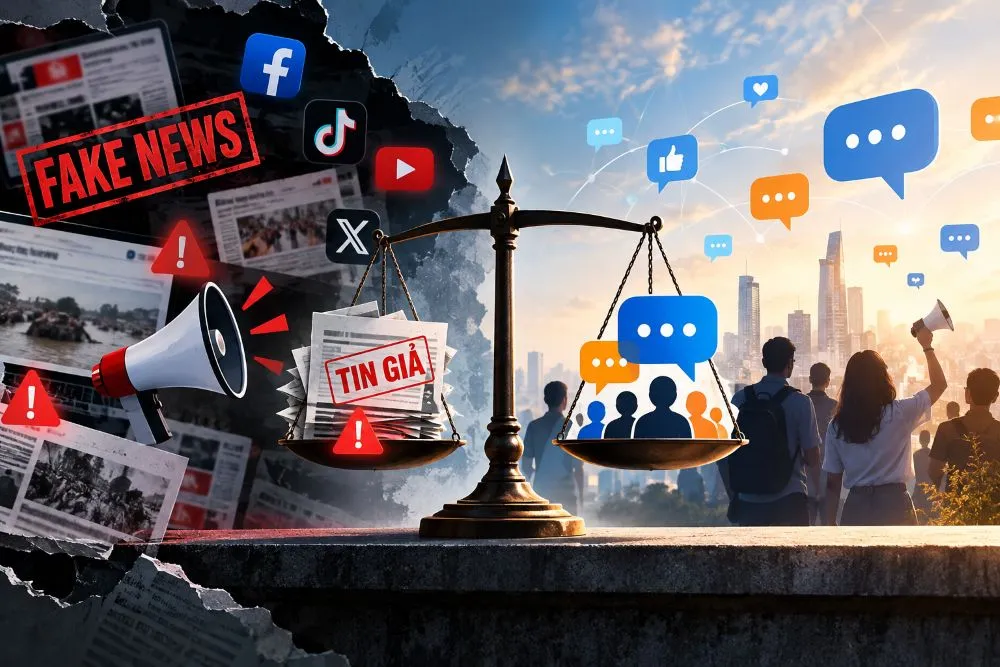
Fake news floods social media, with unpredictable consequences
No longer confined to baseless rumours, fake news on social media is becoming a threat to the information environment and public trust. From fabricated stories about individuals’ private lives and false information concerning natural disasters and disease outbreaks to content distorting economic and social activities, many posts have circulated widely before their authenticity could be established. The World Economic Forum’s (WEF) Global Risks Report 2026 ranks misinformation and disinformation second among the most severe global risks over the next two years. This finding shows that fake news has moved beyond online controversy to become a challenge to social life, governance and trust in public institutions.
The concern lies not only in distorted content but also in the speed at which it spreads and its capacity to shape recipients’ perceptions. A Massachusetts Institute of Technology (MIT) study published in Science in 2018 analysed approximately 126,000 stories shared by nearly three million people on Twitter between 2006 and 2017, finding that false information was 70% more likely to be retweeted than truthful content. In particular, true news took about six times as long as false news to reach 1,500 people. Although these findings reflect only Twitter data from the period studied, they nevertheless reveal a thought-provoking feature of information consumption: surprising, shocking or emotionally charged content often has an advantage in attracting engagement. When views and shares determine popularity, unverified information can quickly generate a wave of public opinion, while corrections face considerable obstacles.
Beyond shaping perceptions, fake news also risks eroding trust in official information sources. According to the Reuters Institute for the Study of Journalism at the University of Oxford’s Digital News Report 2026, a survey across 48 markets found that only 37% of respondents trusted most news most of the time, the lowest level since the institute began tracking the indicator in 2015. Meanwhile, 62% of respondents expressed concern about the difficulty of distinguishing between true and false information online, up four percentage points from the previous year. These figures reflect a paradox: the public has more opportunities to access information, yet identifying trustworthy sources has become more complex. When unsubstantiated allegations, fabricated images or manipulated content appear with increasing frequency, recipients not only risk misunderstanding events but may also become sceptical even of verified information.
Behind seemingly harmless posts lies the potential for incalculable harm to individuals, organisations and communities. A false accusation can damage the reputation of the person concerned; unfounded rumours about products or services can affect business operations; and fabricated content during natural disasters or disease outbreaks can cause panic and impede the public’s reception of official guidance. The WEF’s Global Risks Report 2026 also identifies misinformation among the top 10 risks in 67 surveyed economies in terms of threats over the next two years.
The damage caused by fake news does not end when a post is deleted or the account spreading it is penalised. Prejudices already formed, reputations damaged and trust shaken may persist even after the truth is made public. The most serious consequence of fake news, therefore, is not merely that it causes the public to misunderstand information, but that it also undermines the ability to distinguish right from wrong and weakens trust in society.
Challenges in controlling information and protecting freedom of expression
The fight against fake news on social media presents a difficult problem, as the need to maintain order and information security must be balanced with each individual’s right to freedom of expression. Preventing false, distorted or harmful content is necessary, but regulatory measures must not become barriers to legitimate discussion, criticism and expression of opinion. In the digital environment, where information is continuously created, altered and disseminated across national borders, the difficulty lies not only in detecting and addressing violations but also in determining appropriate limits on intervention. This reality confronts online content regulation with numerous challenges involving law, technology and the responsibilities of participating stakeholders.
First, it is difficult to define the boundary between false information and the right to express personal opinions. Not every controversial assertion or view that differs from the majority can be considered fake news. Content may include inaccurate information, subjective interpretations or critical opinions on social issues, requiring different assessments depending on its nature and impact. Article 25 of the 2013 Constitution recognises citizens’ rights to freedom of speech, freedom of the press and access to information, while stipulating that the exercise of these rights is prescribed by law. The challenge is to correctly identify deliberate fabrication and dissemination of unlawful content without equating dissenting opinions with information that must be removed. Without clear criteria and objective evidence for verification, enforcement may lead to inconsistent interpretations and affect people’s ability to participate in discussions of public issues. Determining whether conduct constitutes a violation must therefore be based on accuracy and objective evidence rather than solely on the attention it attracts or the public response it generates.
Second, there is pressure to act swiftly against violating information even though verification requires time and sufficient evidence. Under Decree No. 147/2024/ND-CP, effective from 25 December 2024, social media platforms within its scope must block and remove unlawful content within prescribed time limits, including no later than 24 hours after receiving a request from a competent authority or 48 hours in the case of a substantiated user complaint. This regulation provides a basis for limiting the harm caused by unlawful information, while also imposing stringent requirements on verification capacity and implementation. A manipulated image, an out-of-context video clip or a controversial statement may need to be cross-checked against multiple sources before a conclusion can be reached. If speed alone is prioritised, the risk of mistakenly removing lawful content increases; conversely, delays may allow false information to continue spreading. The central challenge is to ensure timeliness and accuracy while protecting the rights and interests of those who post content.
Third, it remains difficult to ensure that cross-border platforms consistently fulfil their responsibilities in regulatory practice. Facebook, YouTube, TikTok and many other online services operate internationally, while the content they provide in each country must comply with distinct legal requirements. Decree No. 147/2024/ND-CP adds provisions on account authentication, content management and obligations to coordinate in handling violating information for companies providing cross-border services in Vietnam. However, effective enforcement depends on coordination between regulators and service providers, mechanisms for receiving requests and the operation of each platform’s moderation system. Algorithms can help identify signs of problematic content, but they cannot always accurately assess linguistic nuances, satire or cultural context. When decisions to restrict content are made without adequate explanation, users may find it difficult to understand the reasons and protect their rights and interests. Cyberspace governance must therefore rely not only on sanctions but also on transparency, accountability and mechanisms for reviewing enforcement decisions.
Fourth, users’ legal awareness and information literacy have not kept pace with changes in the digital environment. Although regulations are becoming increasingly comprehensive, many people still habitually comment on, share or draw conclusions about events without checking the origin and reliability of the content. The distinction between the right to express an opinion and acts that defame others, invade privacy or disseminate fabricated information is not always fully understood. Conversely, fear of penalties may make some users reluctant to engage in legitimate criticism. These opposing tendencies both reflect the need to improve awareness of rights and responsibilities in online communication. A healthy information environment cannot be created solely through preventive measures by regulators; it also requires each individual to verify information independently, respect differing opinions and take responsibility for their conduct. Only when users understand both their legally protected rights and the conduct that exceeds permissible limits can efforts to prevent and combat fake news go hand in hand with maintaining an open, responsible and trustworthy space for discussion.
Finding solutions to combat fake news while ensuring freedom of expression in the digital age
In the face of the increasingly complex effects of fake news, the task is not only to prevent false information but also to create a transparent and safe media environment in which freedom of expression is respected and exercised within the law. Experience shows that ad hoc enforcement measures cannot address the root of the problem without coordination among regulators, technology companies, news organisations and social media users. As the methods used to create, manipulate and disseminate content become increasingly sophisticated, removing violating information must be combined with preventive solutions, stronger detection capabilities and efforts to reinforce public trust. Achieving this goal requires the coordinated implementation of legal, technological governance, communications and public education measures.
First, the legal framework should be improved to ensure transparency, consistency and proportionality in addressing violating information. The focus should not be solely on strengthening sanctions, but also on clarifying the criteria used to identify the provision and sharing of false information, particularly content that combines objective facts, personal views and critical opinions. The application of the law must take into account the nature of the conduct, the extent of its impact, its actual consequences and other relevant factors, avoiding mechanical assessments based on how widely content has spread or how online communities have reacted. Procedures for notification, explanation, appeal and review of enforcement decisions should also be improved, enabling users to protect their lawful rights and interests when disputes arise. Any restriction on freedom of expression must have a clear legal basis, serve a legitimate purpose and be applied only to the extent necessary. An effective legal framework is reflected not only in its capacity to address violations, but also in its protection of honest opinions, responsible criticism and the public’s right of access to information.
Second, social media platforms should be held to greater responsibility, alongside public and transparent content moderation procedures. Rather than merely deleting information after complaints arise, service providers should establish early-warning mechanisms, identify potentially fabricated content and help users verify sources before sharing. Posts undergoing verification could, where appropriate, be labelled with warnings or supplemented with links to reliable fact-checking sources, thereby limiting the risk of dissemination without automatically removing the content. Regular disclosure of the number of removal requests, the grounds for action, the proportion of successful appeals and the outcomes of content restoration would also strengthen accountability. Automated moderation systems require human oversight, particularly in complex cases involving context, language and social viewpoints. When governance procedures are made public, users not only gain a clearer understanding of their rights and obligations but also have a basis for monitoring how platforms fulfil their responsibilities to the community.
Third, the role of mainstream journalism in fact-checking information and shaping public awareness should be strengthened. Amid competition to report news rapidly, media organisations need to innovate in how they engage the public, making accuracy, objectivity and explanatory depth the foundations of their credibility. For matters attracting significant public interest, information should be verified through multiple independent sources, published promptly and presented clearly to limit the space available for baseless speculation. Establishing dedicated fact-checking sections, making correction procedures public and strengthening coordination between media organisations and relevant authorities will provide the public with more reliable sources against which to check information. Efforts to debunk fake news should not be merely reactive after public opinion has already been affected; they should prioritise providing original data, explaining context and clarifying potentially misleading issues from the outset. The press must also ensure a diversity of social voices, creating forums where differing viewpoints can be discussed on the basis of facts and in a constructive spirit. When verified information is conveyed convincingly, public trust will be strengthened through the quality of content rather than through preventive measures alone.
Fourth, every social media user should help foster a culture of receiving and sharing information responsibly. A sustainable solution to fake news must begin with the community’s ability to assess information independently, as no regulatory system can control all the content created and exchanged each day. Skills for identifying misinformation, checking sources, comparing evidence and understanding the law on freedom of expression should be incorporated into educational curricula, community communication initiatives and digital skills training. School and university students should be taught to distinguish facts from opinions, recognise manipulated or decontextualised content and develop the habit of questioning information designed to provoke emotional reactions. For adults, public education programmes should be linked to real-world situations such as policy rumours, deceptive advertising, impersonation of government agencies or calls to share unverified information. This approach is consistent with UNESCO’s recommendations on digital platform governance, which emphasise strengthening media and information literacy to empower users while protecting freedom of expression and access to information. When every individual verifies information before sharing it, respects the truth and takes responsibility for their statements, cyberspace will have a stronger foundation for healthy development.
Combating fake news and protecting freedom of expression are not opposing objectives; they must be pursued in tandem to build a safe, democratic and responsible information environment. Regulatory effectiveness is reflected not only in the number of items removed or violations addressed, but also in policy transparency, access to reliable information and the protection of people’s right to express lawful opinions. A healthy online environment is one where the truth is respected, differing viewpoints are heard and those who abuse freedom to infringe upon the lawful interests of others are treated fairly. Only when freedom of expression is protected by law and responsible communication becomes a matter of individual conscience can the fight against fake news achieve lasting effectiveness in the digital age.
Anh Tuấn
References
1. Government of Vietnam (2024), Decree No. 147/2024/ND-CP dated 9 November 2024 on the management, provision and use of Internet services and online information, Hanoi. Available at: https://vanban.chinhphu.vn/?pageid=27160&docid=211654.
2. Egan, J. et al. (2026), Digital News Report 2026, Reuters Institute for the Study of Journalism, University of Oxford. Available at: https://reutersinstitute.politics.ox.ac.uk/digital-news-report/2026.|
3. Kemp, S. (2025), Digital 2026: Vietnam, DataReportal – Global Digital Insights, 8 November 2025. Available at: https://datareportal.com/reports/digital-2026-vietnam.
4. National Assembly (2013, amended and supplemented in 2025), Constitution of the Socialist Republic of Vietnam, Consolidated Document No. 52/VBHN-VPQH dated 21 July 2025, Hanoi. Available at: https://vbpl.vn/TW/Pages/vbpq-thuoctinh-hopnhat.aspx?ItemID=179829.
5. UNESCO (2023), Guidelines for the Governance of Digital Platforms: Safeguarding Freedom of Expression and Access to Information through a Multi-stakeholder Approach, United Nations Educational, Scientific and Cultural Organization, Paris. Available at: https://www.unesco.org/en/articles/guidelines-governance-digital-platforms.
6. Vosoughi, S., Roy, D. and Aral, S. (2018), “The spread of true and false news online”, Science, 359(6380), pp. 1146–1151. DOI: https://doi.org/10.1126/science.aap9559.
7. World Economic Forum (2026), The Global Risks Report 2026, 21st edition, Geneva, Switzerland. Available at: https://www.weforum.org/publications/global-risks-report-2026/in-full/.