


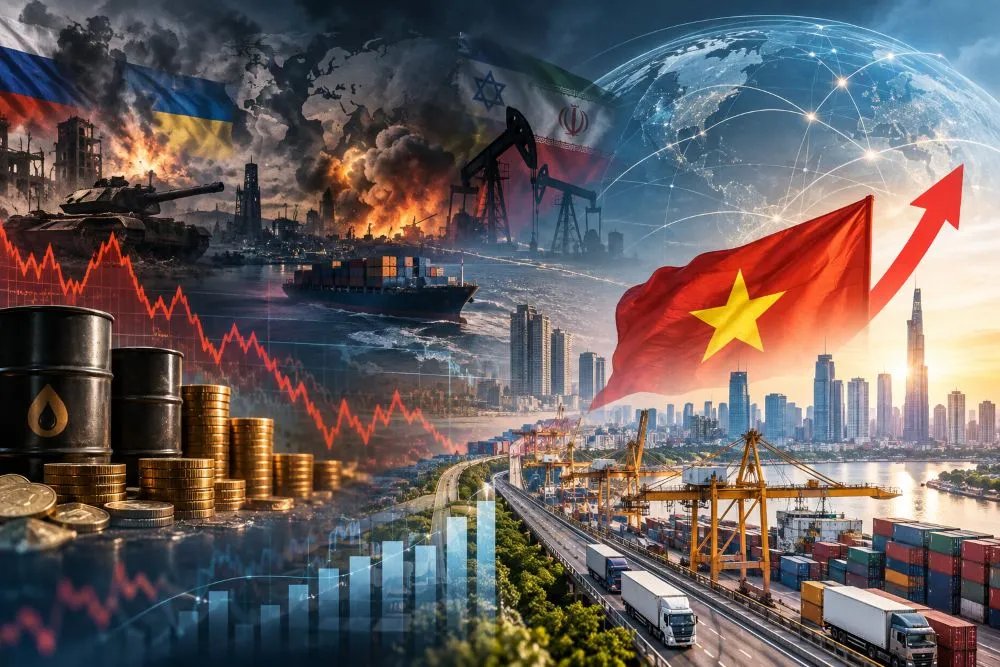
ĐNA - Conflicts thousands of kilometres from Vietnam may seem like political matters concerning distant countries, yet they can directly affect fuel prices, household meals and business production costs. When energy supplies, transport and global supply chains are disrupted, the domestic economy can hardly avoid cascading shocks. Why do distant geopolitical developments affect Vietnam’s economy and people’s lives, and what measures can mitigate the risks?
Geopolitical flashpoints and a widening wave of global instability
As 2026 began, the global situation remained complex, with military conflicts not only destabilising the countries directly involved but also placing mounting pressure on the world economy. From the protracted Russia–Ukraine war to escalating tensions in the Middle East, geopolitical flashpoints are threatening energy security, disrupting vital transport routes and increasing volatility in international financial markets.
According to the World Economic Outlook released on 13 October 2026, the International Monetary Fund (IMF) forecast global economic growth of just 3.1% in 2026, down 0.4 percentage points from the previous year. Inflation was projected at 4.7%, as energy and food prices continued to exert pressure on many economies. These indicators show, to some extent, that geopolitical instability has moved beyond the security sphere to become a major factor affecting growth prospects, production and people’s lives worldwide.
One of the most concerning regions at present is the Middle East, where conflict involving Iran and tensions in the Strait of Hormuz are exposing energy markets to the risk of supply disruption. Located on the maritime route linking the Persian Gulf with international markets, Hormuz is particularly important to oil and gas transportation. According to the United Nations Conference on Trade and Development (UNCTAD), approximately one-third of the world’s seaborne oil passes through the strait. This high degree of dependence means that any adverse development in Hormuz can rapidly affect global energy prices.
On 14 October 2026, Reuters reported Brent crude at approximately USD 105.56 per barrel amid concerns over an increased risk of attacks on commercial vessels. Experience shows that even without widespread supply disruption, risks to a strategic transport route are sufficient to heighten market anxiety and drive fuel-price volatility. When oil prices rise, the impact is not confined to the energy sector but spreads to transport costs, industrial production and commodity prices in countries far from the conflict zone.
Alongside the Middle East, the protracted Russia–Ukraine war continues to place pressure on European energy security and international fuel markets. Attacks on energy infrastructure, risks to Black Sea shipping and trade restrictions have compounded difficulties in fuel supply and distribution. Military developments on 13 October 2026 again demonstrated that the threat of infrastructure and transport disruption in the region remains present.
Notably, the International Energy Agency (IEA) warned that a global diesel shortage could persist until mid-2027, as the conflict in the Middle East and attacks on Russian refineries reduce supply. Beyond causing direct damage, prolonged warfare exposes energy production, trade and distribution to unpredictable risks. Even if diplomatic efforts are advanced, restoring infrastructure, stabilising supply and re-establishing transport routes will take time, meaning the economic effects may persist after military tensions subside.
Beyond energy markets, instability in strategic regions has also exposed vulnerabilities in the international trading system, where economies are increasingly interconnected through transport networks and cross-border supply chains. According to UNCTAD’s Review of Maritime Transport 2025, more than 80% of global merchandise trade by volume is transported by sea. However, cargo volumes passing through the Suez Canal in May 2025 remained 70% below 2023 levels, reflecting severe disruption along key shipping routes.
Faced with security risks in the Red Sea, many commercial vessels have had to reroute around the Cape of Good Hope, lengthening voyages and increasing fuel, insurance and freight costs. These additional expenses are subsequently passed through the importation of materials, production and distribution, placing further pressure on prices in consumer markets.
Pressure on international trade is also reflected in a weaker growth outlook. In April 2026, UNCTAD warned that growth in global merchandise trade could fall from approximately 4.7% in 2025 to 1.5–2.5% in 2026. Alongside changing global demand and other economic factors, global geopolitical tensions continue to increase risks to trade, investment and supply-chain organisation.
In a context where raw materials may be extracted in one country, processed in another and then transported to multiple consumer markets, disruption at a single link can have far-reaching consequences. This also explains why geographical distance is no longer sufficient to shield an economy from external shocks. For Vietnam, a highly open economy deeply integrated into international trade, changes in energy prices, logistics costs or material supplies can all feed into the domestic market, affecting business production, the overall price level and, ultimately, every household’s spending.
From distant wars to price pressures in Vietnamese daily life
Conflicts occurring thousands of kilometres from Vietnam can still directly affect the domestic economy through changes in energy prices, transport costs and raw-material supplies. When global oil prices rise, shipping routes are disrupted or import costs climb, the pressure is felt not only by production and business operations but is gradually passed on to the prices of essential goods and services. According to data released by the National Statistics Office on 3 October 2026, the consumer price index (CPI) rose 0.62% month on month in September and 5.08% from the same period in 2025. Over the first nine months, average CPI increased by 4.52%, while core inflation rose by 4.26%.
These figures show that price pressures are present in the economy, although they cannot be attributed entirely to geopolitical instability. In addition to international market developments, domestic prices are affected by consumer demand, supply costs and policy management. However, when these factors operate simultaneously, external shocks can intensify inflationary pressure, affecting living costs and people’s purchasing power.
The clearest impact can be seen in the petroleum market, where changes in international energy prices can quickly affect domestic travel and freight costs. According to the National Statistics Office, petrol prices rose 9.39% and diesel prices 4.53% month on month in September 2026, pushing the transport price index up 3.97% and contributing 0.4 percentage points to the overall CPI increase. Compared with the same period a year earlier, fuel prices increased by 23.96%, while the transport price index rose 11.67%. These movements demonstrate the domestic market’s sensitivity to changes in energy prices.
Petroleum is not used solely for travel; it is also an important input in transportation, fisheries, industrial production and goods distribution. When fuel prices rise, transport operators face higher operating costs and may consequently adjust freight rates, increasing the cost of moving products from producers to consumers. Oil-market fluctuations in the Middle East, although occurring far from Vietnam, can therefore affect domestic commodity prices through numerous intermediary stages. The scale of the impact depends on the capacity of each business and industry to maintain reserves, regulate supply and absorb costs.
Price pressures have also spread to many goods and services associated with everyday life. Statistics for the first nine months of 2026 show that food and catering services increased by 4.72% year on year, contributing 1.69 percentage points to the overall CPI increase; catering services outside the home alone rose by 7.14%. Housing, electricity, water, fuel and construction materials increased by 6.68%, including rises of 4.35% in residential electricity prices and 13.07% in home-maintenance materials. Although each category is influenced by different factors, simultaneous increases in many essential expenses are placing additional pressure on household budgets.
For food-service establishments, rising costs for ingredients, transportation, packaging and electricity can narrow profit margins, forcing owners to consider price adjustments to remain in business. Consumers, meanwhile, must spend more on recurring needs such as food, travel and household expenses. Even when the increase in each item is modest, the cumulative impact over an extended period can tighten household finances. Low-income households face greater pressure because most of their budgets are devoted to essentials, while their ability to cut or substitute these expenses is relatively limited.
Price movements not only increase the amount paid for goods and services but also affect purchasing power, consumption habits and people’s ability to save. When food, travel and household expenses account for a larger share of income, many families may have to reduce non-essential spending, postpone purchases or save less. Changes in consumer behaviour can, in turn, affect businesses as demand for certain products and services weakens, reducing revenue and their ability to sustain operations.
At the third-quarter 2026 meeting of the Domestic Market Management Team, regulators observed that military conflicts, trade restrictions and sanctions between countries could continue to affect supplies of raw materials, fuel and agricultural inputs, increasing import costs for production. This shows that price pressure does not necessarily end when military tensions ease, as supply-chain disruptions and the restoration of supply can persist. For a highly open economy such as Vietnam, limiting the effects of international volatility, stabilising markets and protecting people’s purchasing power are becoming increasingly important. Behind changes in oil prices, freight rates and inflation indicators lies the challenge of balancing income and expenditure and maintaining stable lives for millions of Vietnamese families.
Challenges facing Vietnam’s economy amid international volatility
As conflicts and geopolitical tensions affect the global economy, Vietnam must both sustain growth momentum and ensure macroeconomic stability. As a highly open economy deeply involved in international production and trade networks, Vietnam cannot avoid the effects of external market volatility on imports and exports, industrial production, investment and finance. According to the National Statistics Office, Vietnam’s total merchandise trade turnover reached USD 888.02 billion in the first nine months of 2026, up 30.4% year on year.
The growing scale of trade demonstrates the economy’s level of integration while also creating a need to improve its capacity to respond to difficult-to-control external risks. Notably, pressure arises not only from the direct damage caused by conflict but also from market uncertainty, which makes businesses more cautious in production planning, investment and contract signing, while confronting regulators with greater difficulties in forecasting and management.
First, the risk of supply-chain disruption presents a major challenge to domestic production, particularly as many industries remain dependent on imported raw materials, machinery and components. From electronics and textiles to chemicals and industrial processing, the input supplies of Vietnamese businesses are closely linked to international manufacturers and transport systems. According to a National Statistics Office report released in October 2026, merchandise imports reached USD 453.72 billion in the first nine months, with capital and intermediate goods accounting for 94.1%. This proportion reflects strong import demand for production while also highlighting the risks when supply from partners is disrupted or shipping costs increase sharply.
Even a delay in the arrival of raw materials can force businesses to adjust production schedules, seek alternative suppliers, increase inventories or accept additional costs to fulfil orders. Small and medium-sized enterprises face even greater pressure because they have limited reserve capital, weaker bargaining power with partners and fewer alternatives when markets fluctuate. In the long term, dependence on a small number of major supply sources can also reduce business autonomy, affecting the ability to maintain stable production and participate more deeply in global value chains.
Alongside input supplies, exports are also under pressure from changes in demand and the trade policies of partner markets. As a major driver of growth, Vietnamese exports depend significantly on international purchasing power, particularly in large markets. Data for the first nine months of 2026 show merchandise exports reaching USD 434.30 billion, of which the US market accounted for USD 140 billion. Maintaining trade relations with partners that have large consumer markets enables production to expand and turnover to increase, but also makes businesses more sensitive to changes in tariffs, technical standards and import regulations.
As global geopolitical tensions persist, importers may alter purchasing plans, reallocate orders or tighten requirements regarding product origin and supply-chain stability. Labour-intensive industries such as textiles and garments, footwear, wood processing and seafood may be affected if orders decline, delivery times lengthen or contract-fulfilment costs increase. Under such conditions, businesses must not only find ways to retain markets but also improve product quality and added value and diversify partners to reduce the risks of dependence on a few key export markets.
In financial markets, exchange-rate movements and international capital flows are factors that may place additional pressure on macroeconomic stability. When global geopolitical risks increase, investors often adjust portfolios and move capital into assets regarded as safer, thereby affecting exchange rates, interest rates and financing conditions across economies.
In Vietnam, businesses that import raw materials or machinery or have foreign-currency payment obligations are vulnerable to sharp exchange-rate movements. If the Vietnamese đồng depreciates against the settlement currency, import costs and foreign-debt repayments may increase, narrowing profit margins and complicating financial planning. Conversely, unpredictable exchange-rate movements also create difficulties for importers and exporters in determining prices, costs and the effectiveness of long-term contracts.
In its Global Financial Stability Report released on 13 October 2026, the International Monetary Fund (IMF) warned that risks related to higher bond yields, public debt and asset-price volatility could place pressure on the global financial system. This requires Vietnam to closely monitor market developments, manage monetary policy flexibly and limit abnormal fluctuations while ensuring access to capital for production and business.
Instability in the international environment also affects investment decisions and the competitiveness of Vietnamese businesses. When energy prices, raw-material costs and financing expenses fluctuate continuously, businesses must be more cautious about expanding production, investing in equipment and implementing long-term projects because costs and payback periods are difficult to estimate. The pressure is greater for energy-intensive industries or those with low profit margins, where higher input costs can reduce investment efficiency and limit the ability to expand operations.
According to Reuters on 12 October 2026, high liquefied natural gas prices and shortages of gas-turbine equipment were affecting the progress of several gas-fired power projects in Asia, including Vietnam. This demonstrates that global geopolitical instability not only raises immediate production costs but may also delay energy-infrastructure development, affecting the ability to secure electricity for industrial production and attract investment. Meanwhile, shortcomings in logistics infrastructure, technological capacity and workforce quality, if not addressed promptly, could disadvantage domestic businesses against competitors with higher productivity and more flexible supply chains. The challenge is therefore not only to sustain production and business during periods of instability but also to improve technological innovation, use resources efficiently and strengthen competitiveness to adapt to changes in international markets.
From a policy-management perspective, the greater challenge is to reconcile growth objectives with the need to preserve macroeconomic stability amid numerous unpredictable external factors. Supporting businesses, promoting investment, controlling inflation and maintaining major economic balances require close coordination among fiscal, monetary and trade policies. If support measures lack focus, resources may be dispersed and policy effectiveness reduced; conversely, excessive tightening could restrict access to capital and impede production and business recovery.
According to the National Statistics Office, Vietnam’s GDP was estimated to have grown by 9.01% year on year in the first nine months of 2026, reflecting positive growth momentum despite persistent international uncertainty. However, this result does not mean that the economy has avoided external risks, particularly as production and exports remain closely linked to global markets.
A World Bank report released in May 2026 also emphasised the need to improve productivity, strengthen linkages between domestic businesses and the foreign-invested sector, and increase the value created and retained within the economy. These are important factors in consolidating the foundations for growth, reducing dependence on short-term advantages and improving adaptability to international volatility.
Vietnam’s challenge is therefore not merely to maintain growth rates in each period, but also to improve the quality of growth, enhance the autonomy of domestic production and strengthen the economy’s resilience to external shocks.
Strengthening economic resilience to geopolitical shocks
As military conflicts and global geopolitical tensions can rapidly affect energy, trade and financial markets, strengthening resilience has become an important requirement for Vietnam’s economy. Although no country can entirely avoid the effects of international volatility, it can limit its vulnerability through forecasting capacity, resource autonomy and effective policy management. In its Vietnam economic update released on 15 May 2026, the World Bank emphasised the role of reform, productivity improvements and stronger linkages among business sectors in consolidating growth prospects amid uncertainty. Vietnam therefore needs to shift its focus from responding to immediate effects towards building a flexible economic foundation capable of adapting and remaining stable through prolonged shocks.
First, improving forecasting capacity and proactively developing response scenarios are essential to minimising external risks. Because the global geopolitical situation can change rapidly, policy management cannot rely solely on measures taken after disruption has occurred; risks must be identified early and appropriate plans prepared. Regulators need to closely monitor energy prices, the trade policies of major partners, international transport operations and capital-flow trends to assess impacts on individual industries and sectors.
On this basis, developing scenarios for multiple levels of risk will help determine in advance the policy response, resource allocation and coordination required when markets experience abnormal developments. Resolution No. 168/NQ-CP, issued by the Government in June 2026, updated the growth scenarios while requiring coordination between fiscal and monetary policies and measures to remove obstacles to production and business.
To improve implementation, Vietnam must continue refining its data systems, strengthen information sharing among ministries and sectors, and establish early-warning mechanisms to give businesses more time to adjust production, import and raw-material inventory plans. Response capacity therefore depends not only on available financial or material resources but also on detecting risks early enough to limit damage before their effects spread.
Alongside stronger forecasting capacity, diversifying import and export markets and reinforcing supply chains are measures that must be implemented in a coordinated manner. When international trade is affected by conflicts, trade restrictions and transport disruption, excessive dependence on a small number of partners can leave businesses vulnerable to sudden market changes. Vietnam should therefore effectively utilise its existing free trade agreements while expanding relations with promising markets to spread risks at both the input and output ends.
According to Reuters on 14 October 2026, Vietnam and the European Free Trade Association (EFTA), comprising Switzerland, Norway, Iceland and Liechtenstein, were expected to sign a free trade agreement on 18 October 2026, opening new prospects for cooperation with partners beyond traditional markets. However, the effectiveness of diversification is measured not only by the number of agreements or volume of trade but also by the ability to access markets, meet international standards and maintain operations when one link in the supply chain fails.
Businesses should proactively seek alternative suppliers, establish contingency plans for raw materials, transport and distribution, and minimise production stoppages when imports are disrupted. In parallel, developing supporting industries, enhancing the capacity of domestic suppliers and improving logistics infrastructure will increase the autonomy of domestic production and reduce dependence on difficult-to-control external sources.
Another important task is to strengthen energy security and ensure stable supplies for production and daily life. Developments in the Middle East show that fuel markets can be strongly affected when strategic transport routes are threatened, while higher energy prices generally increase the costs of shipping, production and goods distribution. Vietnam must maintain supplies of petroleum, electricity and other essential fuels under a range of scenarios, including prolonged disruption in international markets.
According to the Ministry of Industry and Trade, Vietnam’s 2026 plans for responding to international volatility were designed to diversify petroleum import sources, encourage long-term supply contracts and maintain commercial reserves in accordance with regulations. In the long term, Vietnam needs to expand storage capacity, ensure the efficient operation of its refining and petrochemical system, and become more proactive in balancing domestic supply with imports.
In addition, economical and efficient energy use and the development of power sources suited to practical conditions will help reduce pressure when fuel prices fluctuate. For renewable energy, capacity expansion must be accompanied by investment in transmission grids, storage systems and dispatch capabilities to ensure stable and safe utilisation of power supplies. With coordinated investment in energy infrastructure, diversified supply and adequate reserves, the economy will have greater room to respond to fuel-price shocks from global markets.
In macroeconomic management, policy instruments should be used flexibly alongside measures to support businesses and protect vulnerable groups. In the face of international volatility, market stability cannot rely solely on short-term price controls but requires coordination among fiscal, monetary and social-security policies. Regulators must closely monitor inflation, exchange rates, interest rates and financial-system liquidity to select appropriate measures that limit abnormal volatility without excessively restricting capital for production and business. Support policies for businesses directly affected by higher input costs or disrupted orders must be properly targeted, time-limited and subject to clear evaluation criteria, prioritising the preservation of jobs and restoration of operations. Social-security measures should also target low-income workers, poor households and groups with limited capacity to save, who are particularly vulnerable when prices for essential goods and services rise.
Under the direction set out in Resolution No. 168/NQ-CP, the Government requires targeted fiscal policy and coordinated measures to stabilise monetary and foreign-exchange markets. Implementation must ensure effective use of the state budget, public-debt safety and the maintenance of the economy’s major balances. The objective of policy management is not only to keep macroeconomic indicators stable but also to limit the impact of crises on business operations, employment and living standards.
In the long term, strengthening endogenous capacity and renewing the growth model are fundamental to reducing Vietnam’s vulnerability to geopolitical volatility. Short-term responses can help stabilise markets at particular moments, but the capacity to sustain long-term growth depends primarily on productivity, technological capabilities, workforce quality and business competitiveness. Vietnam must therefore enable domestic businesses to participate more deeply in global value chains and gradually take on stages with higher technological content and added value. Stronger linkages with the foreign-invested sector should be tied to the development of domestic suppliers, technology transfer and improved management capacity, rather than merely expanding the scale of processing and assembly.
The World Bank report released in May 2026 also emphasised the need to improve productivity, strengthen linkages among business sectors, and increase the share of value created and retained in Vietnam’s economy. Achieving these objectives requires continued improvements to the investment environment, development of strategic infrastructure, promotion of digital transformation and support for business research and technology adoption. Greater autonomy does not mean reducing integration or seeking to supply every resource domestically; rather, it means proactively selecting partners, diversifying supplies and improving substitution capacity when external markets fluctuate. With more productive domestic industry, competitive businesses and efficient resource use, Vietnam will be better positioned to seize the opportunities offered by integration while limiting the risks arising from excessive external dependence.
As geopolitical conflicts may continue to affect the global economy, Vietnam’s resilience must be built through both policy management and the foundations of domestic production. Proactive forecasting, market diversification, energy security, macroeconomic stability and stronger endogenous capacity are not separate tasks but must be pursued through a long-term strategy coordinated between the State and businesses. External shocks may be unavoidable, but their impact on the economy and people’s lives depends on preparedness and adaptability. This will also enable Vietnam to sustain its growth momentum while consolidating the foundations for stable development in an increasingly unpredictable international environment.
Although geopolitical conflicts occur thousands of kilometres from Vietnam, they can have far-reaching effects on the economy, from energy prices and production costs to trade, investment and people’s lives. In a world of increasingly interconnected and interdependent economies, no country can entirely avoid external shocks. The degree of vulnerability, however, depends not only on the scale or nature of the disruption but also on each country’s internal strengths, adaptability and policy effectiveness.
For Vietnam, economic resilience must therefore be understood not merely as the ability to overcome periods of instability, but also as the capacity to maintain production, safeguard macroeconomic balances, protect people’s purchasing power and preserve long-term development momentum. To achieve this, measures involving risk forecasting, market diversification, energy security and macroeconomic stability must form part of a consistent strategy to improve productivity, strengthen autonomy and enhance the quality of growth.
Deep integration can become a sustainable advantage only when the economy is capable of seizing external opportunities without becoming excessively dependent on a single market, supply source or growth driver. Ultimately, the strength of an economy is measured not only by growth figures in favourable times but also by its ability to withstand crises, limit losses for businesses and citizens, and establish the foundations for continued development amid unpredictable changes in the international environment.
Thế Nguyễn – Anh Tuấn
References
1. Government of Vietnam (2026), Resolution No. 168/NQ-CP dated 27 June 2026 on updating growth scenarios and key measures for the remaining quarters to achieve the 2026 growth target of at least 10% while maintaining macroeconomic stability, Hanoi. Available at: https://congbao.chinhphu.vn/van-ban/nghi-quyet-so-168-nq-cp-469893/66402.htm.
2. National Statistics Office (2026), Press release on the socio-economic situation in the third quarter and first nine months of 2026, released on 3 October 2026, Hanoi. Available at: https://www.nso.gov.vn/du-lieu-va-so-lieu-thong-ke/2026/10/thong-cao-bao-chi-tinh-hinh-kinh-te-xa-hoi-quy-iii-va-9-thang-nam-2026/.
3. National Statistics Office (2026), Press release on prices in September, the third quarter and first nine months of 2026, released on 3 October 2026, Hanoi. Available at: https://www.nso.gov.vn/tin-tuc-thong-ke/2026/10/thong-cao-bao-chi-ve-tinh-hinh-gia-thang-chin-quy-iii-va-9-thang-nam-2026/.
4. International Energy Agency – IEA (2026), Oil Market Report – October 2026, released on 14 October 2026, Paris. Available at: https://www.iea.org/reports/oil-market-report-october-2026.
5. International Monetary Fund – IMF (2026), World Economic Outlook, October 2026, Washington, D.C. Available at: https://www.imf.org/en/publications/weo/issues/2026/10/13/world-economic-outlook-october-2026.
6. World Bank (2026), Vietnam Economic Update, May 2026, released on 15 May 2026, Washington, D.C. Available at: https://documents1.worldbank.org/curated/en/099740005122628080/pdf/IDU-2ee874ce-e0c0-462b-9571-99e553ef83c9.pdf.
7. Nguyen, Thu-Ha Thi (2026), Viet Nam Macro Monitoring, 8 October 2026, World Bank, Washington, D.C. Available at: https://documents.worldbank.org/en/publication/documents-reports/documentdetail/099014110082634935.
8. United Nations Conference on Trade and Development – UNCTAD (2025), Review of Maritime Transport 2025: Staying the Course in Turbulent Waters, released on 24 September 2025, Geneva. Available at: https://unctad.org/topic/transport-and-trade-logistics/review-of-maritime-transport.
9. World Economic Forum – WEF (2026), The Global Risks Report 2026, 21st edition, released on 14 January 2026, Geneva. Available at: https://www.weforum.org/publications/global-risks-report-2026/in-full/.
10. World Trade Organization – WTO (2026), Global Trade Outlook and Statistics, March 2026, Geneva. Available at: https://www.wto.org/english/res_e/publications_e/gtos0326_e.htm